
Thank you for joining us during our Introduction to Shibari event! Here’s a glimpse at some of my personal notes when it comes to rope bondage.
I’m neither an expert nor am I a medical professional so take them with a grain of salt and a bucket of your best judgement.
That said, I hope that you continue to seek out learning when it comes to rope here or abroad—or consider going through our compilation of resources on the Shibari.ph website!
We’ve covered during the skillshares that danger is an ever present part of bondage. We’ve compiled links so you can remember crucial details like general safety tips and where it’s safe to tie your partner (since just avoiding joints isn’t enough)!
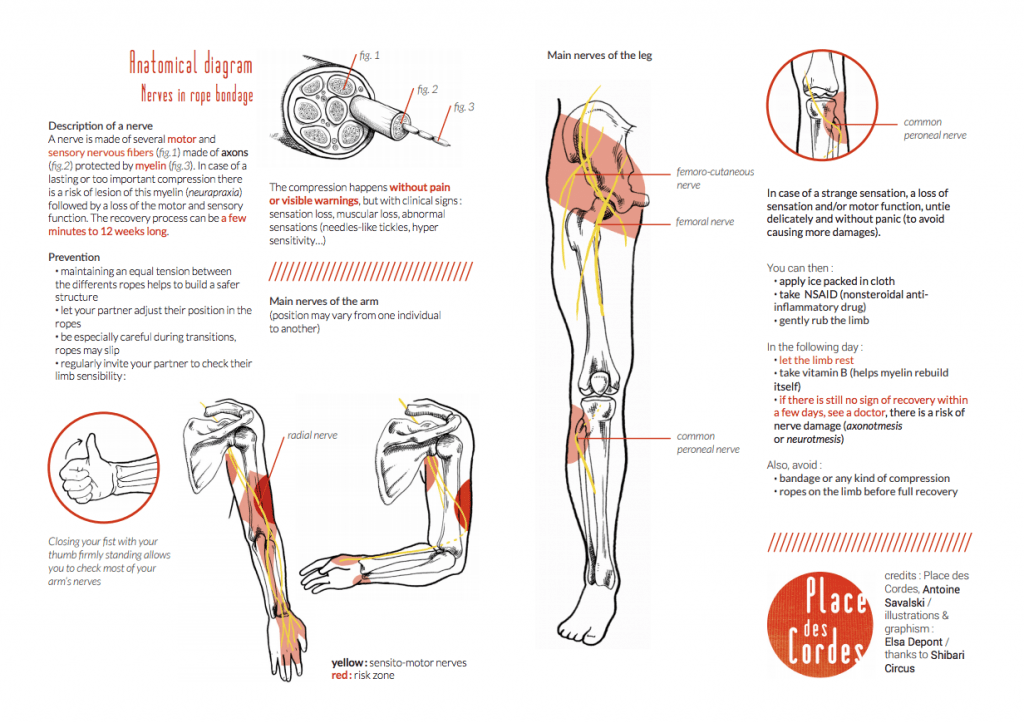
Find this “Nerve Damage Flyer” and more links when you visit our Resources Page and scroll down to the Safety References.
Sugar rushes tend to come with a crash and the same applies to Kink Spacing during bondage being followed by Kink Dropping.
We hope that your experience was a positive one and hope that saying goodbye to the natural high from kink doesn’t bring with it any of the unpleasant feelings and hard-to-describe issues that come with Dropping.
However, if it does, that’s perfectly normal and not a sign of weakness on your part!
Click below to find resources on providing proper aftercare when your partner feels down by visiting our Resources Page and scrolling to After Your Session!
There are different ways to end/lock the single column tie: we have options like the square knot, the granny knot, the fast bowline, and more.
Each of these have their distinct advantages/disadvantages, one of those being the likelihood in which the knot might collapse when under different situations.
Jute rope tends to have better tooth or friction that keeps its knots in place, so I prefer using the Marumusubi (aka Somerville Bowline) especially when I use synthetic rope that are smoother.
This gives me peace of mind, knowing it won’t collapse as a result of pulling hard, bouncing, and when subject to other conditions, etc.
Over time, you’ll develop your own style or preference when it comes to tying your knots, manipulating rope, and doing your checks.
When doing the Marumusubi, I prefer to form the loop by twisting the rope and pulling the rope head (nawagashira) through it. This gives me an easier time, especially when I’m working with rope that uses a longer rope head (like in certain kinbaku styles).
Here’s a video sharing 4 ways you can tie the Marumusubi so you can pick one that’s more intuitive or natural for you:
Need to store your ropes? Here are Renai Rai’s three (3) ways to bundle your ropes!
Send us an email at [email protected] or message us through the Shibari.ph Facebook Page.
Happy tying!
